Foreword
It has been over a year since Barbie Hsu (known as Da S, which means Big S) passed away, yet the debate surrounding her estate is far from over. From Koo Jun Yeop’s public statement renouncing his inheritance, to reports in July 2026 that he had instructed a solicitor to apply to overturn the notarised waiver document, and on to Wang Xiao-fei setting up a trust account for their two minor children—every step of this inheritance dispute, involving over NT$650 million, has drawn public attention.
However, what truly merits attention is not the dramatic plot twists of a high-society feud, but a repeatedly demonstrated truth: when there are gaps in a wealth structure, even the clearest intentions may come to nothing in the eyes of the law. Da S’s case brings this proposition into sharp relief—in this dispute involving an estate worth NT$650 million, three generations and two marriages, what kind of predicament will the gaps in the wealth structure thrust her beloved family into?

I. A Real-Life Case OverwhelmedbyLabels
Da S, whose real name is Barbie Hsu, is a renowned Taiwanese artist and one of the most recognisable figures in the Chinese-speaking entertainment industry. She made her debut as a singer and later rose to fame across Asia for her role as “Shan Cai” in “Meteor Garden”, remaining active in fields such as presenting, fashion, film and television for nearly three decades. Her public image was striking—passionate and uncompromising, and extremely protective of her family—a trait that was vividly demonstrated in the care she provided for her mother, Huang Chunmei, and her younger sister, Dee Hsu ( also known as Little S), during her lifetime.
The complexity of her family’s financial situation and structure is equally noteworthy. According to estimates by Taiwanese media, the total value of her estate is approximately NT$650 million to NT$1 billion, comprising a luxury residence in Taipei’s Xinyi District (which still has an outstanding mortgage), a property at the Gallery (where her Mom has resided for many years), cash assets and income from brand endorsements, amongst other assets. In terms of her family, Da S has a son and a daughter (both minors) with her former husband Wang Xiaofei. She remarried Koo Jun Yeop, a South Korean entertainer in 2022, and her mother, Huang Chunmei, had been assisting with the management of her financial affairs for many years.
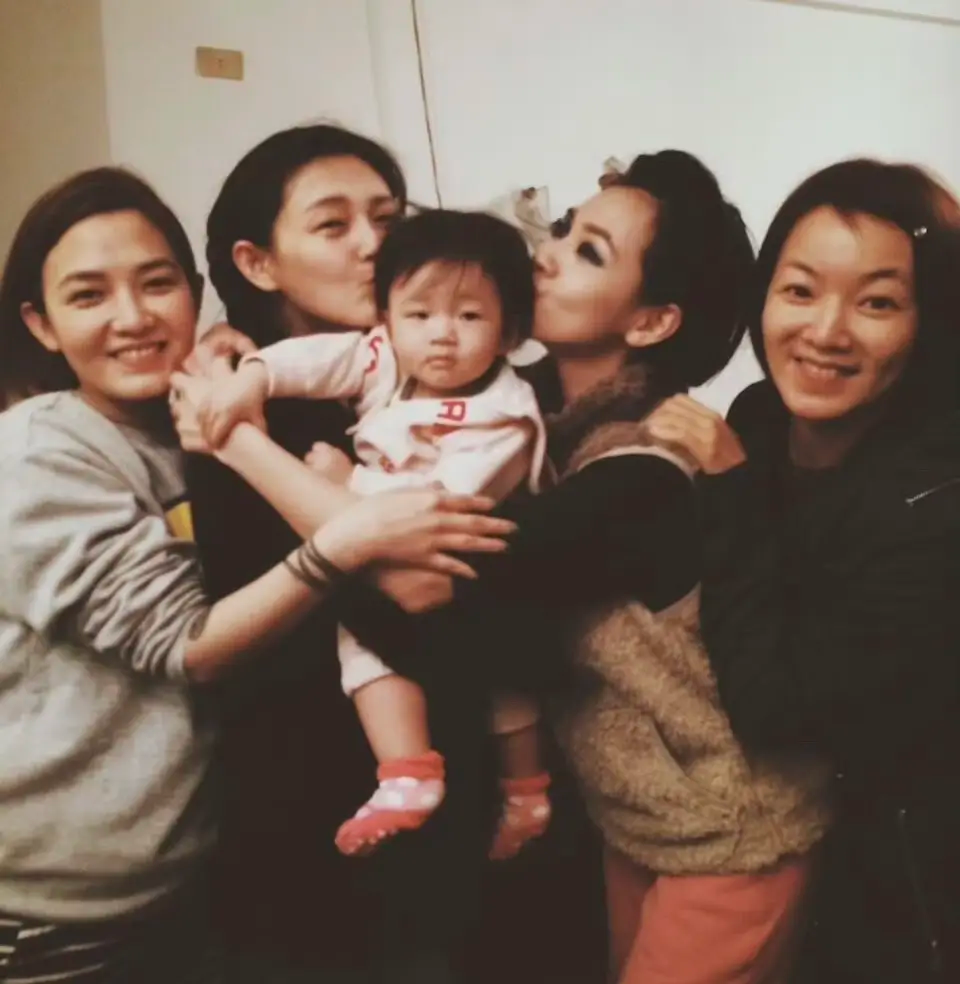
However, Da S sadly passed away in February 2025, a sudden turn of events that took the public by surprise. Given this complex family structure in terms of spanning generations, marriages and geographical locations, there is the fact that she had not drawn up a valid testament during her lifetime, thus immediately triggering a protracted dispute over her estate.
Although the media later revealed that her mobile phone notes contained a record of her wishes regarding the distribution of her assets, according to the strict provisions of Taiwan’s Civil Code regarding the form of a testament, mobile phone notes carry no legal validity whatsoever. The absence of an estate became the first domino to fall in the entire inheritance dispute.
Ⅱ. Limitations of Statutory Inheritance: What It Can and Can’t Solve?
As of September 2026, the dispute over the distribution of the estate in this case continues to evolve. The following analysis, based on the Taiwan’s Civil Code, reflects the logical framework of the statutory inheritance system, though the rules do not necessarily represent a final outcome. From Koo Jun Yeop’s public statement renouncing his inheritance to reports in July 2026 that he had instructed his solicitor to apply to have the notarised waiver document set aside, it is clear that, in the absence of a testament, any interim distribution arrangement may be altered by the parties’ legal actions, and the final outcome remains uncertain.
The case of Da S first highlights a widespread misconception amongst the public regarding the statutory inheritance system. Many believe that “the law will naturally take care of everything”, but the essence of statutory inheritance is “distribution according to order of priority and proportion”, rather than “arrangement according to the testator’s wishes”. According to Taiwan’s Civil Code, the first-order heirs are lineal descendants (children), with the spouse inheriting jointly with the heirs of that orders.
●Koo Jun Yeop, as the spouse, is in the same line of inheritance as the two children; in principle, the three would divide the estate equally, each receiving one-third;
●As Da S’ mother, Huang Chunmei belongs to the second-order heir, whilst first-order heirs are alive, she has no direct statutory right of inheritance.
This raises a key contradiction: statutory inheritance safeguards “legal kinship”, rather than “de facto emotional investment and contributions”. Ms. Huang Chunmei assisted Da S with her financial affairs for many years and resided long-term in a property registered in her name; yet, in the eyes of the law, these contributions cannot be converted into inheritance rights or rights of residence. Management rights do not equate to ownership, and the fact of residence does not equate to property rights—this is a grey area that the statutory inheritance system fails to cover, and a cruel reality that many families only realise after a tragedy has struck.
Furthermore, the process of administering statutory inheritance itself entails a time cost. From the inventory of assets and verification of debts to the settlement of taxes and fees and the division of shares, it is not uncommon for the entire procedure to take several months or even years. For family members who rely on the deceased’s income to sustain their daily lives, this period of uncertainty in itself poses a risk.
Ⅲ. Limitations of a Testament: It Answered “To Whom”, Yet Not Necessarily about “How To Give”
Due to the fact that testament was not established during Da S’lifetime, frequent questions were asked: If she had established a testament, could relevant questions be issued?
The fact that Da S did not draw up a testament during her lifetime had led the public to ask: if she had made a testament, would that have resolved the issue?
The answer is not simply “yes”.
Inevitably, a legally valid testament in Taiwan can significantly improve the clarity of estate distribution. Taiwan’s Civil Code recognises five forms of testament; in practice, a notarised testament is the most highly recommended: Under the presence of a notary public and two witnesses, it carries the lowest risk of formal defects and is the most difficult to overturn in the future.
However, the protective power of a testament has two inherent limitations.
The First Limitation: Compulsory-Portion System
Taiwan’s Civil Code establishes a“Compulsory-portion system”, which constitutes the minimum guaranteed share for statutory heirs——even if the testament specifies otherwise, this compulsory portion cannot be deprived. The statutory reserved share for lineal descendants, parents and spouses is one-half of their statutory inheritance share. In other words, even if Da S were to draw up a testament leaving her entire estate to her children, Koo Jun Yeop, as her spouse, could still legally claim a reserved share of approximately one-sixth. A testament cannot completely circumvent the statutory inheritance system; rather, it serves to optimise the distribution within its framework.
The Second Limitation Is Even More Crucial: The Absence of Dynamic Management.
A testament is, by its very nature, a one-off, static allocation instruction—it answers the question of “who gets what”, but is virtually powerless to address the following issues:
●Who will manage the assets? Who will act as guardian to manage the assets inherited by the two minor children? In this case, custody is legally vested in the biological father, Wang Xiaofei, but does this align with Da S’ s wishes?
●How should the assets be managed? Should they be handed over to the guardian in a single lump sum, or disbursed in installments? How can the security of the assets be guaranteed if the guardian remarries or encounters financial difficulties? In this case, Wang Xiaofei has established a trust account for his children through a special representative appointed by the court, thereby achieving relatively independent management—yet such arrangements cannot be enforced by a testament alone.
●When should the assets be transferred? Is it the best solution for children to receive the entire estate in a lump sum once they reach the legal age of majority? Are there mechanisms in place to prevent the loss of assets due to extravagance, fraud or marital breakdown?
●Whose opinion should prevail in the event of a dispute? When the guardian and other family members disagree on how the assets should be used, the testament itself does not provide a mechanism for resolving such disputes.
These questions spark a deeper conclusion: a testament addresses “static distribution”, but what wealth inheritance truly requires is “dynamic management”. For complex families involving minor children—particularly when family members have had different marriages across generations—a testament alone is far from sufficient.
Ⅳ. Family Trust: From “One-off Distribution” to “Continuous Protection”
If statutory inheritance is “passive acceptance” and a testament is a “static arrangement”, then a family trust provides a wealth framework characterised by “proactive planning, dynamic management and continuous protection”.
1. The Core Operational Mechanism of a Trust
In a trust legal relationship, the settlor (the person establishing the trust) transfers a portion of their assets to the trust, and the trustee (such as a bank’s trust department or a specialist trust company) manages and distributes the assets for the benefit of the beneficiaries in accordance with the terms of the trust deed. This arrangement fulfils at least three key functions:
●Asset Isolation: Trust assets are legally distinct from the settlor’s personal assets; they are not subject to probate proceedings following the settlor’s death, nor can they be subject to claims arising from the beneficiaries’ marriage, debts or changes in guardianship.
●Conditional management: The settlor may set out distribution conditions in advance, such as children only being able to receive the principal once they reach the age of 25, no age restrictions on educational and medical expenses, or the suspension of distributions in the event of major life changes, thereby ensuring that the assets always serve the settlor’s true intentions.
●Multi-tiered oversight: A trust supervisor (protector) may be appointed to oversee the trustee’s execution of duties and hold a veto over major matters, thereby establishing a three-tiered protection system comprising’s “execution by the trustee, supervision by the supervisor, and legal safeguards”.
2. Comparison : Suitable Scenarios on Three Types of Inheritance
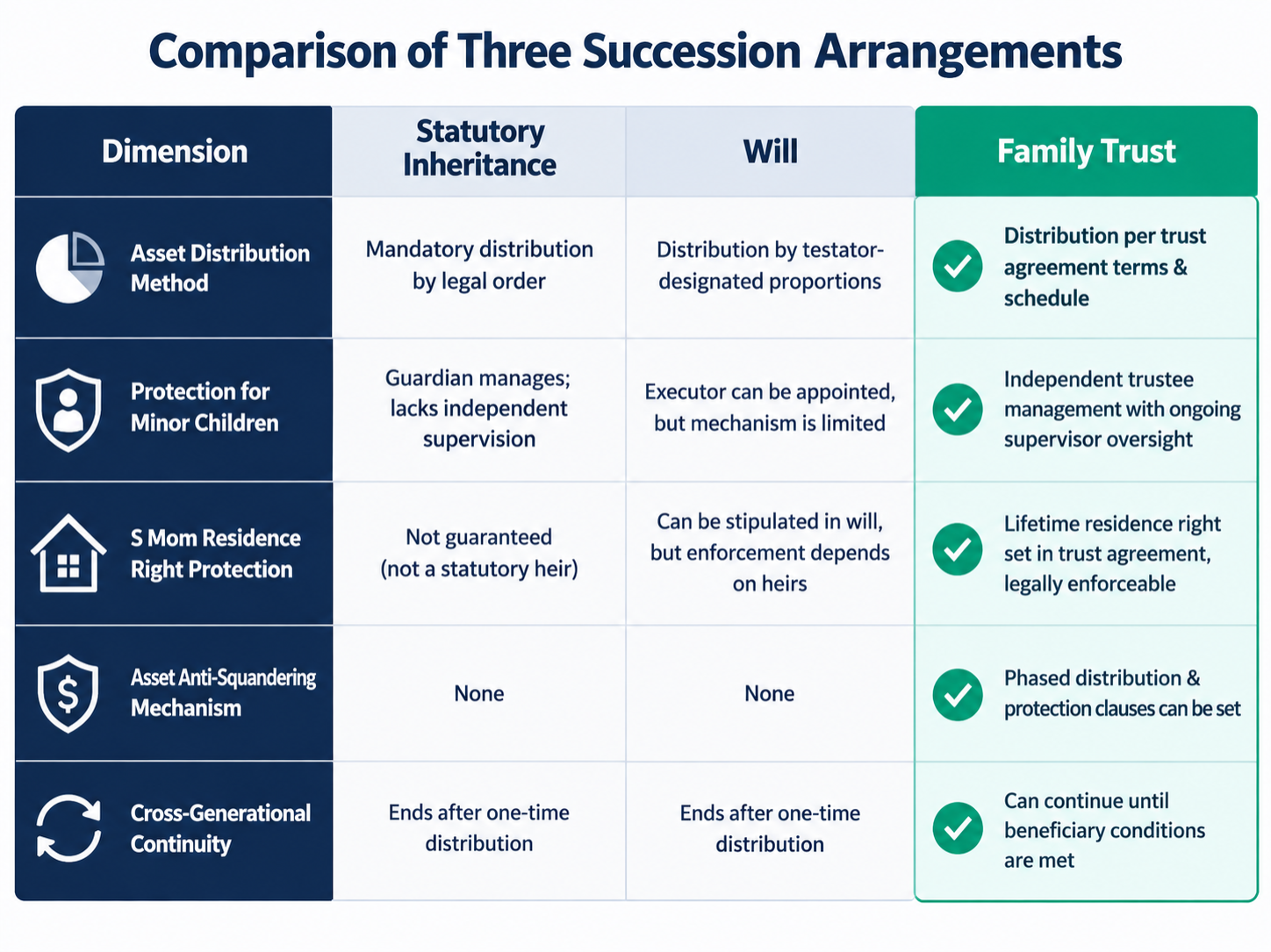
To clearly demonstrate the differences between the three types, the following comparison is based on the circumstance of this case:
3. If Da S Had Set up a Family Trust during Her Lifetime
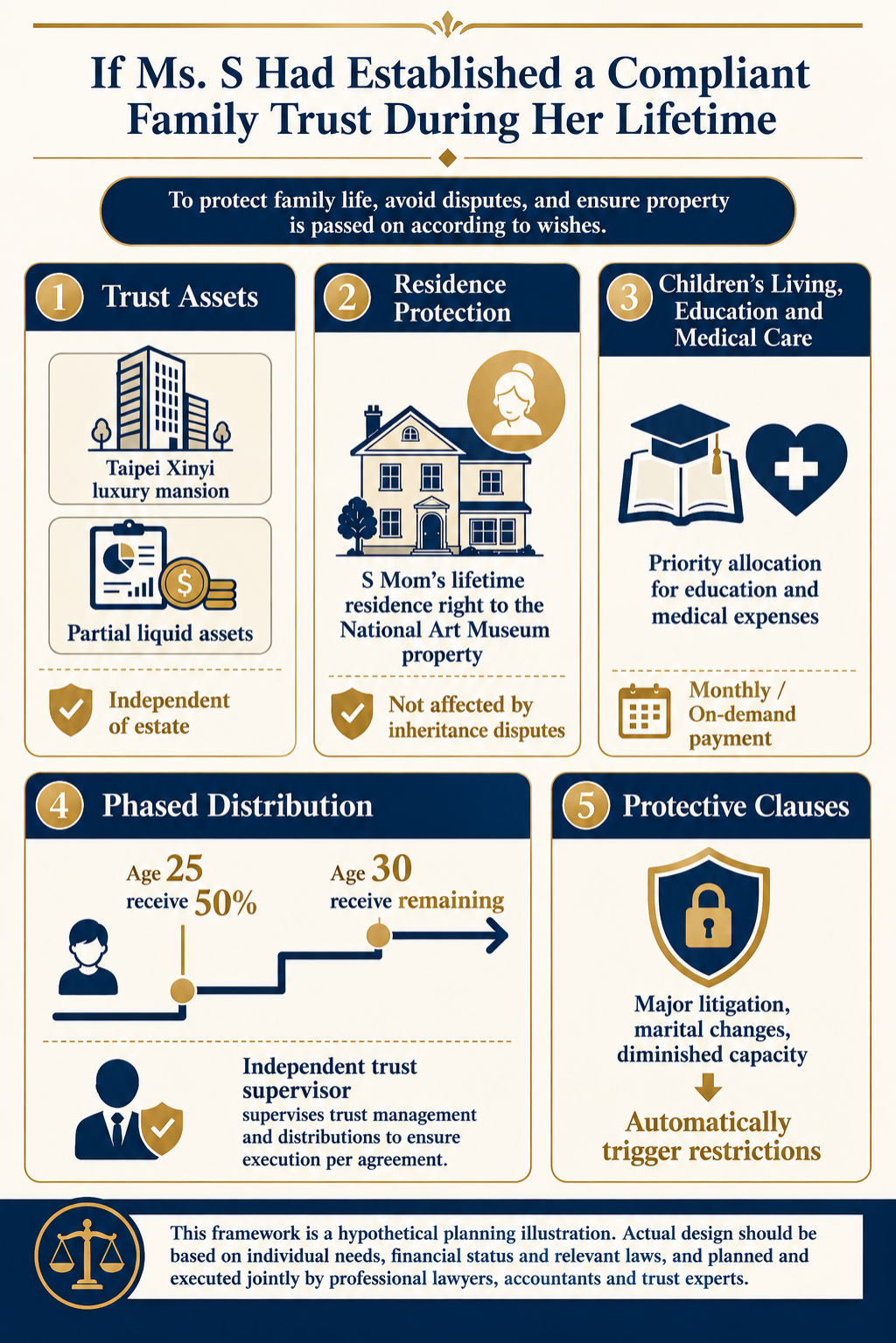
Turing back to the present case, if Da S had set up a family trust during her lifetime through compliant procedures, the likely rationale behind the planning would be as follows:
●Placing the “Taipei Xinyi” luxury residence and certain liquid assets into the trust, thereby separating them from the estate;
●Explicitly stipulating her mother’s lifetime residency right in the property of the Gallery, ensuring it remains unaffected by any disputes over inheritance rights;
●Establishing a mechanism for the priority allocation of funds for the children’s education and medical expenses, to be paid monthly or as and when required;
●Stipulating that the children shall acquire the assets in installments upon reaching adulthood (e.g. 50 % at the age of 25 and the remainder at the age of 30), with an independent trust supervisor overseeing the implementation during this period.
●Setting out clear beneficiary protection clauses, such as automatic triggering of protective distribution restrictions in the event of major litigation, marital breakdown, or a court ruling that the beneficiary’s legal capacity has been impaired.
In this way, what Da S leaves behind will no longer be a legal dilemma requiring family members to face off in court, but rather a long-term mechanism that spans the life cycle and naturally cares for the loved ones. A trust does involve with “who gets how much”, but rather a series of more fundamental questions: “how it is received, when it is received, and what it is used for”.
Ⅴ. The Mindset behind Wealth Structures in High-Net-Worth Families: From “Remedial” to “Proactive”
In the face of vast wealth and complex family relationships, relying solely on any single tool—be it verbal promises, statutory inheritance or a testament—is far from sufficient to build a robust framework for wealth inheritance. The reason the case of “Da S” has sparked such widespread discussion is that it exposes not an isolated incident, but a widespread blind spot in the wealth planning of high-net-worth families.
The following three misconceptions are particularly common:
Misconception 1: “My family gets on very well; we don’t need any of this.” Family harmony is the starting point for wealth inheritance, but it is not the end point. Sudden misfortunes, changes in the external environment, or even well-intentioned but divergent decisions can all cause cracks to appear in what were once harmonious relationships under pressure. The very purpose of a structured plan is to build a buffer against uncertainty whilst relationships are still stable.
Misconception 2: “I’ve discussed this verbally; my family all know what I mean.” Verbal promises carry virtually no legal weight. In the case of Da S, Koo Jun Yeop’s public statement that he would “cede his inheritance rights to S’s mother” still required a formal notarised waiver procedure to take legal effect; subsequently, it sparked further controversy when he claimed “his signature had been coerced”. This serves as further proof that intentions not set out in legal documents are, in essence, merely wishes.
Misconception 3: “We’ll deal with it later; it’s still too early.” Planning a wealth structure has nothing to do with age or health, but everything to do with the size of one’s assets and the complexity of one’s family situation. When a family involves minor children, intergenerational assets, or family members from different marital relationships, every day of delay increases the uncertainty. And the most regrettable outcome is often that “when you want to speak up, it is already too late”.
A truly mature approach to wealth management involves establishing a framework whilst the situations are calm, rather than seeking remedial solutions only when things get worse. Family trusts, testament planning, and other complementary tools such as the appointment of guardians and insurance arrangements—these should not operate in isolation, but rather be combined, with the assistance of professional advisers, into a comprehensive solution tailored to the family’s specific circumstances.
Conclusion
The controversy surrounding Da S’s estate, when it comes down to it, cannot be explained by the choices or negligence of any single family member; rather, it was an inevitable structural impasse resulting from gaps in the wealth structure. When verbal promises cannot be honoured, statutory inheritance fails to reflect emotional investment, and testament cannot address the need for dynamic management, what we require is a more forward-looking approach to wealth inheritance —shifting from “to whom” to “how”, and from “remedying after the event” to “planning in advance”.
The ultimate significance of wealth lies not in the figures themselves, but in whether it can continue to safeguard loved ones in accordance with the owner’s wishes. When life’s script cannot be rehearsed, a comprehensive plan is the most responsible and heartfelt script we can write for our families. This is precisely the core value of wealth structure planning.
Disclaimer
The content of this article is based on a review of publicly available legal provisions and industry practices, and is intended solely for the purposes of information sharing and academic discussion. The content of this article does not constitute professional advice on legal, tax, investment or trust matters in any jurisdiction. It is recommended that you seek independent professional advice on legal, financial and tax matters before taking any action regarding wealth planning.