Foreword:
On 1 April 2003, Leslie Cheung, a Hong Kong superstar, passed away at the age of 46, leaving an estate worth approximately HK$400 million. According to publicly available probate records, this wealth was not channeled through a trust structure, nor were there any complex financial arrangements; the transfer was completed solely by means of a legal estate . In the public imagination, this appears to be a “simple yet dignified” example of wealth inheritance. However, when re-examined from the perspective of professional wealth planning, the question this case truly raises is: what are the extremely difficult-to-replicate conditions that enabled an estate to achieve an effect akin to that of a trust? And when these conditions are not met, what kind of risk exposure is revealed?
Leslie Cheung’s entertainment career spanned both music and film; from his debut in 1977 until his passing in 2003, he accumulated considerable personal assets. This estate consisted primarily of cash, property and a small number of vehicles, and its structure was relatively straightforward. In terms of specific distribution, he bequeathed approximately half of his assets——including cash, a holiday villa in Thailand and three luxury cars——to his beloved partner, Daffy Tong Hok-tak; the remainder was distributed equally amongst his brothers, sisters and niece.
From a legal perspective, this was a clearly structured estate with unambiguous provisions. Judging by the outcome of the distribution, no public disputes over the estate arose amongst family members. Precisely for this reason, many commentators have cited this case as evidence that “an estate is sufficient to replace a trust”. However, this conclusion overlooks a key variable: whilst emotional consensus within the family may, under specific circumstances, temporarily substitute for the function of institutional safeguards, emotional consensus itself is not an asset that can be planned for or inherited.
Ⅰ. From the Unique Aspects of Leslie Cheung’s Estate Arrangements: How Does “Emotional Pricing” Work?
In Leslie Cheung’s instance, his estate arrangements can be executed smoothly, at the very least, on the following special conditions:
● A high degree of acceptance amongst family members: During his lifetime, his special care for family members, coupled with the family members’ respect for his personal choices, fostered a rare form of emotional capital. In the distribution, such a capital has effectively mitigated underlying conflicts of interests.
● A relatively simple estate structure: The assets consisted primarily of cash and property, with no complex corporate shareholdings, cross-border assets or assets requiring ongoing management. Consequently, the execution of the estate did not require the handling of onerous valuation, division or ongoing management issues.
● A relatively clear external debt situation: Public records show no evidence of substantial outstanding debts or potential legal claims against Leslie Cheung during his lifetime, enabling the estate to be distributed within a relatively short timeframe without the need to set aside a buffer for debt repayment.
● The personal circumstances of the heirs were relatively straightforward: At the time of inheritance, there were no public records of marital changes, bankruptcy risks or other circumstances that might have led to third-party claims against the assets of Daffy Tong Hok-tak and his family members.
Each of these four conditions is rare to encounter individually; the likelihood of all four being present simultaneously is even lower. The absence of any single conditions could potentially undermine “the legal estate” model. This explains why the “Leslie Cheung Model” is extremely difficult to replicate in practice.
II. The Boundaryof an Estate: What It Can and Cannot Do
As the most fundamental tool for wealth inheritance, the core function of an estate lies in “one-off distribution”. It clearly expresses the testator’s wishes, designates the beneficiaries of assets, and ensures enforcement within the legal framework. In Leslie Cheung’s case, this function of the estate was fully realised. However, the institutional boundaries of an estate are equally clear:
●An estate cannot insulate assets from risk: once assets have been inherited, they become part of the heir’s personal estate. Should the heir subsequently face marital upheaval, debt disputes or business operational risks, the inherited assets may likewise be affected.
●An estate cannot facilitate intergenerational management: an estate only addresses the question of “to whom the assets are given”, not “how the assets are managed”. If the testator wishes for assets to be distributed at a specific pace or used for specific purposes (such as education, healthcare or business start-ups) over the coming decades, an estate struggles to provide effective institutional safeguards.
●The execution of an estate relies on cooperation amongst the heirs: in the absence of a third-party oversight mechanism, the effective execution of a will depends heavily on the heirs’ integrity and cooperation. Should conflicts arise amongst the heirs, the estate itself cannot compel the resolution of such disagreements.
These limitations did not constitute a practical obstacle in the case of Leslie Cheung, precisely because the aforementioned “emotional pricing” mechanism served as a substitute. However, this precisely illustrates that the success of an estate depends, to a considerable extent, on variables beyond the testator’s control—namely, the state of emotional relationships within the family.
III. Functional Boundaries Between Estates and Trusts
The core function of an estate is to express intent—specifying the beneficiaries of assets and the proportions in which they are to be distributed.
The core function of a trust, on the other hand, is to exercise control—allowing the settlor to exert ongoing influence over the management of assets, the timing of distributions, the conditions for distribution, and the eligibility of beneficiaries, even after ownership of the assets has been transferred.
The key differences between the two can be summarised as follows:
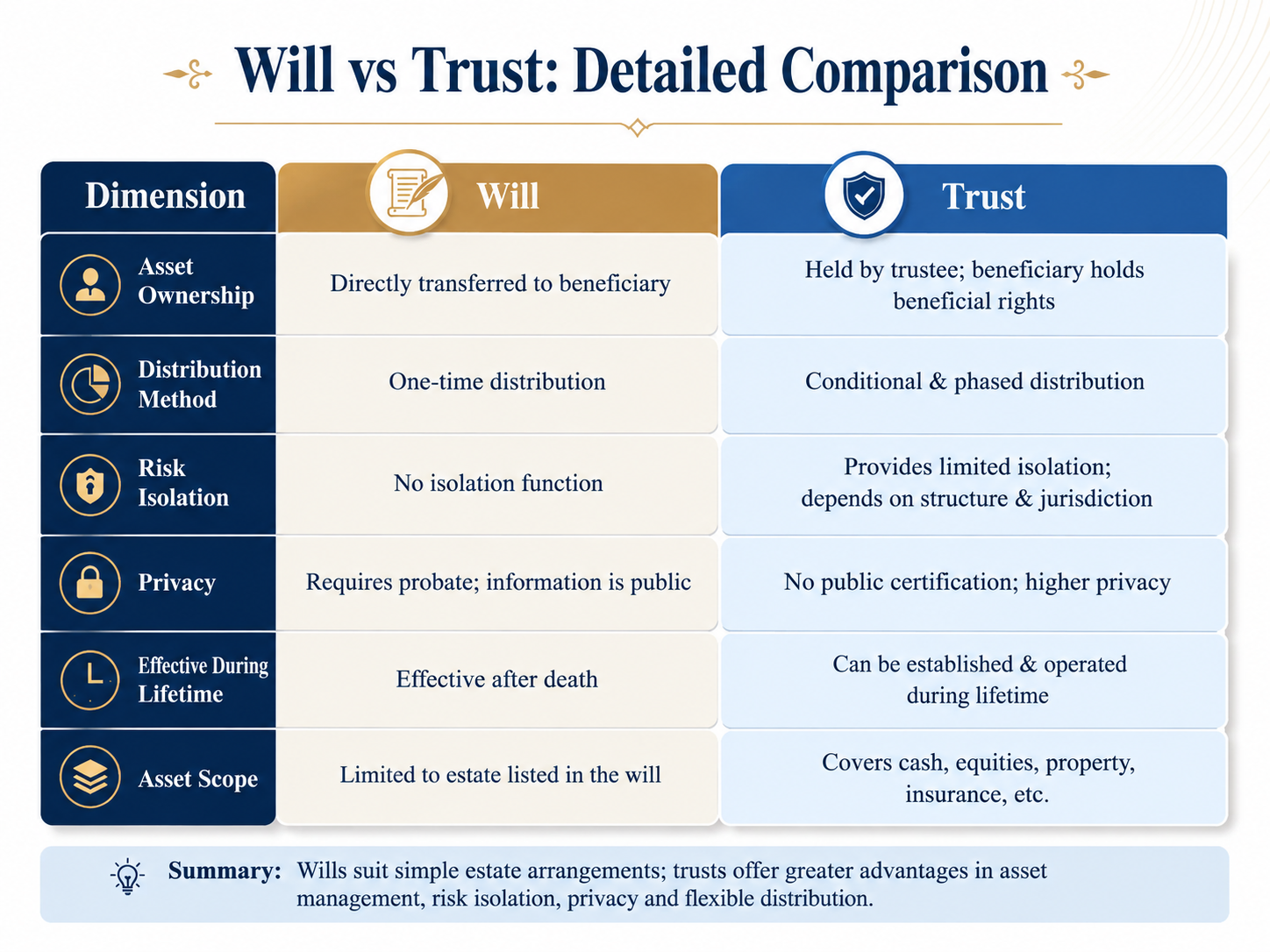
In other words, an estate addresses the question of “to whom the assets are to be bequeathed”, whilst a trust addresses the questions of “how, when and under what conditions the assets are to be transferred”.
Where the value of the estate is modest, the family structure is straightforward, and the heirs’ financial circumstances are sound, an estate may well suffice. However, when the composition of the estate is complex, there are potential conflicts of interest amongst family members, or the heirs themselves face risks relating to marriage, debt or business operations, the institutional safeguards offered by a trust cannot be replaced by an estate.
IV. From Individual Cases to General Principles: The Rational Approachto Modern Wealth Inheritance
Leslie Cheung’s estate planning was shaped by the context of his era and his personal circumstances. In the era in which he lived, awareness of trusts was not yet widespread within the Chinese community, and the options for cross-border trust structures were far less diverse than they are today. More importantly, his personal emotional capital within the family was sufficient, given the circumstances at the time, to ensure a smooth handover.
However, we must not treat exceptional cases as the norm. In today’s environment, high-net-worth families face far more complex asset structures: cross-border assets, family business shareholdings, multiple tax residencies and complex family compositions. The combination of these variables makes it significantly more difficult to achieve wealth inheritance relying solely on wills and emotional consensus.
Truly sound inheritance planning does not involve choosing between a “estate” and a “trust”, but rather constructing comprehensive arrangements—comprising estates, trusts, insurance and other tools—tailored to the family’s specific circumstances. Leslie Cheung preserved his dignity through his estate; this was a victory for his personal emotional capital. Nevertheless, for the majority of families, true protection stems from the rational application of institutional tools. Ensuring that assets are transferred to specific individuals at a specific time and in a specific manner—this is precisely the certainty that a trust can be regarded as an institutional tool.
Disclaimer
The content of this article is based on a review of publicly available legal provisions and industry practices, and is intended solely for the purposes of information sharing and academic discussion. The content of this article does not constitute professional advice on legal, tax, investment or trust matters in any jurisdiction. It is recommended that you seek independent professional advice on legal, financial and tax matters before taking any action regarding wealth planning.